Camera purchases go in spurts for me. And I think I'm in one of those spurts...
Of course, you already know about the 20D. It is still on its way. Man, I wish their shipping was faster.
Oh, and I haven't decided on the SquareTrade warranty yet, but my post ended up getting a reference on the SquareTrade News blog. Looks like SquareTrade (which has at least one more blog started this month) is actively attempting to counter their bad press (and doing focus groups). This is a good thing for consumers like us, because if they care about their reputation, they are going to lean towards pleasing the customer in any grey area situations. Most likely I'll be getting that warranty, but I want to look over the 20D (and Canon's warranty) first. The other thing I've purchased recently is a couple of 2GB Kingston Ultimate 133X from MPEX. I found out about the deal at Strobist (go to Strobist for the link to the cards under rebate). At $19 each, shipped (after rebate), I couldn't pass it up. Quantities are limited, but they have some left as of today. I recommend going with the USPS priority mail shipping, it is $6.50 for the two cards. My main complaint about MPEX is their website isn't that great and it doesn't even show the shipping cost until you've already paid. I e-mailed them to ask about shipping, and while they took a day or two to respond (after I placed my order) they seem on the ball. Also, according to Stuart: "Also, just so you know, we are working on a new site. It will be ready to launch in October."
The main reason I didn't go larger was my desire to reduce risk if a card goes bad. I figure more, smaller cards are better than fewer, bigger cards. I'd hate to lose a whole day's photos if one goes bad. BTW, for my XT (and 20D) I can fit about 250 RAW files on a 2GB card. Oh, and I'd be lying if I said the cost of the larger cards didn't factor into my decision.
Also, I spent the extra few bucks on the 133X cards because I'm finding I'm using continuous mode a little more often, especially in macros when I'm not sure my focus is right. Instead, I stick it on rapid-fire and spray shots while moving closer or further away, with the assumption that one or two will have the right depth of field and focus. But with only 4 frames of RAW buffer (6 on the 20D) I find it fills up really fast, in just over a second. The 133X should help that buffer clear faster so I can space my bursts closer together.
Edit: Aww, crap. Looks like Kingston cards are slow. See Rob Galbraith's CF/SD card comparisons (a year old) and the comments on the original Strobist post. This review isn't as bad though. Oh well, at least the price is good :) Another item I'm planning on purchasing right after I get the 20D is extra batteries. Depending on the condition of the battery I get with the 20D, I'll either get 1 or 2 BP-511A's from eForcity. I got my extra 350D batteries from eForcity and was really pleased with the service, shipping speed, and quality. Oh, and don't forget the cost: new batteries for $12 shipped is a deal.
Finally, I almost bought a Lightsphere II Cloud C1 for my Sunpak 383, but someone else beat me to it (it was used on DPC). While I don't really need a flash diffuser (or at least I don't use flash a lot) the price was too good to pass up. Oh well, I guess I'll have to figure out how to make one with tupperware and tape.
Oh yeah, I've been slowly working on my Hardware Inventory. Within the next few days I hope to have it up to date, and compete a Software Inventory. Knowing what hardware I've bought (and the value of it) will help me when I evaluate my break-even level for doing portrait shoots.
Friday, June 29, 2007
Spending Spree
Thursday, June 28, 2007
A Business Plan Guide
 I ran across a good business plan link in a DPC thread so I thought I'd share it. It is a very complete outline for a business plan, and although it is from the Vermont Small Business Development Center, it is pretty much independent of locality and relevant for almost everyone. Obviously, if you are like me and you won't be applying for outside funding, this type of thing is overkill, but it is a great way to keep track of everything you need to worry about. The exercise of writing a business plan, even an informal one like mine, is a great way to get your thoughts focused and make progress.
Personally, I need to find a resource that gives me a checklist for what I need to do to set up a business in my area. I'm ok delaying though, because I'd like to first determine if my business plan will work before I start buying insurance, permits, web space, etc. Two resources I found are:
- Silicon Valley SBDC: Of note is the legal structure page, a good summary of the differences and how to register. Also provides free counseling.
- US Small Business Administration: A huge site with tons of information including a small business planner.
Wednesday, June 27, 2007
The Playoffs!


vs.
I've talked about DPChallenge and the DPL before, but I wanted to tell you the most recent news:
After losing our first match, we (Team Light) worked hard and managed to squeak out a win based on the best average entry score within our conference. The complete score sheet is here. Submissions for the first round of playoffs start next Monday!
Now, for the bad part: our first playoff matchup is against the best team in all of the DPL: The Ribbon Hogs. These guys' lowest score that counted is higher than our average score! In fact, their lowest score that counted toward the DPL season is basically at my personal best, so I'm going to need to step up to give my team a chance to beat them.
But, I feel I'm ready. I've been looking through previous DPC contests to determine exactly what the voters are looking for, and I've learned a bit. I'll share that with you in a future post. Plus, I currently have an image in the voting stage which should give me a new personal best unless the score collapses (it is still early). My goal is to put in two of the best entries that I can do, and spend as much time as needed to do it. I don't want to be the one that lets down my team.
Not to say Team Light will win, but we'll take our shot. If we do win, it will be David taking down Goliath, the Colonists beating the British, Skywalker conquering Vader (without the family stuff), the Cinderella Man, the Miracle on Ice! We'll be legendary!
Monday, June 25, 2007
20D Purchased; SquareTrade
Last night I won a 20D on eBay for $640 (including shipping). It is a refurbished model, body only. Maybe $10 more than the going rate, but I didn't want to wait the week it might take to get a lower price (the same seller is selling a lot of them).
I had a bit of a decision between a refurbished body and a used body, but I decided to go refurbished because Canon refurbs have a 90 day warranty. If it doesn't break in 90 days, it probably won't break for quite a while. Another thing I'm considering is a SquareTrade warranty. For 10% of the purchase price, I can get 2 years of warranty (either fixing or replacing the camera). I haven't yet decided if it is worth spending $60 on a two year warranty since I'll already have a 90-day warranty on the camera.
But, two years, if I keep going at my current rate, is about 50K shutter actuations, which is around half of what you can usually expect to get out of a 20D. And, since it is a refurb, who knows how much mileage is already on the camera before I get it. The warranty is starting to look pretty good, but I'd like to be sure before I go ahead with it.
After some research, this is what I found out:
- Their sample warranty in plain English. Seems to be good, 2 years, starting 60 days after purchase (my 90 day Canon warranty would cover that) complete repair, replacement, or refund. Accidental damage not covered, but from the web, it doesn't seem like they are too quick to call it accidental.
- Some reviews on Yelp, quite favorable.
- According to this, Digital Cameras have a 10% failure rate after 3-4 years. Honestly, with the work I'll be putting the camera through, I think it will be more than that. Digital SLRs are pretty complicated machines.
- An extra FAQ, most notably saying I can get a SquareTrade warranty 30 days after purchase. Nice.
- Also, you can cancel or transfer the warranty at any time. So if I decide I don't want it in the first 60 days, I can cancel it and get a full refund.
- There's one guy on eBay that really doesn't like them. But his points aren't great (of course they don't cover accidental damage!).
- There's a long forum thread about the times SquareTrade has screwed up. According to SquareTrade, this was a separate company they contracted out to, but they've since terminated that relationship and now they handle the warranties themselves. Recent reviews are positive, including the end of that forum thread above.
Completely independent, I need to look into insurance to cover myself if my camera is lost or stolen (and cover my lenses, since they are worth more than the camera). But that's a post for another day.
Friday, June 22, 2007
Anatomy of a Photo: Light-Painted Lens

So I'm not updating at the rate I normally do because my parents are in town visiting and I'm a bit busier than normal. As a result, my posts this week will also be shorter than normal, although that's probably a good thing, because I tend to be long-winded (just ask my wife).
Aidan of That Photo Over There left a note on my final Canon EF 70-200mm F/4 USM Review about the light-painted image I used to start the post, so I thought I'd explain what went into the image. Aidan just started his blog but his posts are already high quality. In fact, he recently reviewed the Centon FG105D, a cheapo flash which includes an LCD and multi-flash (turns the flash into a strobe light). It can't sync with the eBay triggers though, which is definitely a problem. I'll look into it for the multi-flash capabilities alone; there are a few gimmicky pictures I'd like to try which require a strobe.
Ok, back to the lens photo. The technique used is Light Painting: the use of a moving continuous light source to illuminate the subject and/or produce light patterns on film. It was an outtake for Light Painting III at DPC that just wasn't interesting enough (I ended up submitting Dragon Dad, which had flawed execution but was conceptually good). The previous light painting challenges at DPC have some amazing images, check them out (LP1, LP2, LP3). I didn't take a picture of the set-up with the lens in place, but it was the same set-up as the image at left (click to see larger). I covered a box and the background with a black blanket, using a book underneath the blanket to lift the subject up. The camera was placed on the tripod shown and I used the flashlight (a blue mini-mag light) with black construction paper snoots/light guides to control where the light fell. The snoot shown is a narrow angle one that I didn't actually use for the lens -- instead I used a 6" cylindrical snoot with a 3/4" diameter.
 The object in the image is a little wedding statue my wife has, pictured at right. This was one of my favorite images of my outtakes; I just love the soft lighting you get from moving the light source. I've been using light painting more lately because of the increased control over the source, hardness, and direction of the light (especially useful with reflective objects).
I shot in RAW to give me some leeway in exposure. For the wedding picture, the stats are ISO 100, 20 second exposure, and f/11. For the lens picture, the stats are ISO 1600, 30 second exposure, f/20. I used ISO 1600 to allow f/20 and a huge depth of field.
I used two main tricks for the lens picture:
- The projected light. The projected light is not photoshopped in, it is the light cone produced by placing the snooted flashlight behind the lens (shining into the glass). To register it on the image, I taped thin blue tissue paper to a plastic spoon and moved that paper in front of the lens (along the path). I did clone out a little gap in the cone, but that was minor (and only in this image).
- Dual color light on the lens. So, after I traced the light cone, I removed the flashlight from behind the lens and painted the lens itself, taking care to get light in front of the lens (to show the opening) and highlighting the 70-200mm text. Then, at the last minute, I put a red gel in front of the flashlight and put some red back lighting on the lens to add a little more interest and separate it from the background.
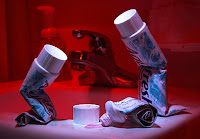 Overall, I probably did maybe 30 pictures over two days to get a lens shot I was semi-happy with. Light painting is a bit like performance art. I like it a lot, and I used the technique on my toothpaste image at right (click the image to go to the DPC page).
The best part is, light painting doesn't require any expensive equipment, just a flashlight, a tripod, and your camera. Make sure you use mirror lock-up (if you have it) and the self-timer (or remote release) to trigger the exposure. I also recommend getting a gel swatchbook (1 cent at B&H) -- the little gels work great for holding in front of flashlights (or taping to the front of your flashes).
And, if you do any light painting, leave a comment, I'd love to see the results!